Sunday, April 23, 2006

How to Slide a Chicken Under the Door

The other day I was trying to find out a way to slide a chicken under a door; This conundrum proved tougher than the Da Vinci Code and no, I have not yet found out a viable, noncasualty way of doing so. However, you might be awed to hear the wealth of options that went through my head:

1. Chloroform it- pluck out the feathers- roll it flat by a rolling pin- make a roti shape- slide it through;
2. Saw off the bottom portion of the door, at least 2 feet high- tell the chicken to walk through the opening;
3. Write 'a chicken' on a piece of paper- alternatively DRAW a chicken- slide the paper through;
4. Take the chicken's beak- insert it through the slit, ignoring the wild sqawks- and just keep pushing until it emerges on the other side- you might have to clip its clawnails first though;
5. Take a razor sharp knife- slice the chicken into very thin layers- place all layers, one after the other, on a rolled out toilet paper ('spreadsheet')- tie a string on the front of the spreadsheet- pull it gently from the other side of the door.

Is anybody concerned about the gravity of the situation? Last night, I called Kantipur Television to tell them of my developments, but after hearing 'Who is this guy?' in the background, I quickly hung up. I don't know, I got too scared...

Labels: , ,

Wednesday, August 31, 2005

When Ants Go Marchin' in Your Space

"The next time you espy a wayward ant on your book or workspace, before you start getting antsy, recall the technique that has been perfected by the science crusaders."
Findings show that it is frustrating that ants are too tiny to be blown away by our exhalations. This frustration is much deep-rooted than we think. It starts from spotting an ant in our private space, and usually lingers on the subconscious so that the next time we see another ant, we experience a new round of frustration just from reflecting the fact that we were unsuccessful at getting rid of the ant in the previous encounter.
Stink it up
There have been many studies done to ease this woe. Antoine, one of the Wacky Boys at Pradhan Labs, had been working on the StinkIt project. The project entailed a subject ingesting something foul and emitting an odorous breath over the ant. The objective is to make the ant faint from the stench, and thereafter to flick it off by the nail of one's left pinkie. Test items to be ingested included raw garlic cloves, and glasses of bagmati water and local liquor. However, the stink was too overwhelming and caused some human casualty. Also, more resistant ants were instead barfing up, adding to the stench. It was a big olfactory mess. StinkIt had to be defunded.
Brewing Oral Storms
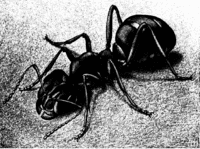
The other option is obviously to blow the ant away from the surface. One complication is that the ants sense the storm before it hits them. They take to crouching onto the ground, after which no amount of force can move them. In fact, Anton Ground, a mathematician, proved that if the air-force is sufficiently powerful, the book on which the ant is holding its stance will first get blown away.
(pic: The Crouch Posture)

The Violent Blow

In June 2005, Antoine, the same engineer of the Wacky Boys fame, upped the ante. He devised another ant-ridding technique, whose effectiveness has wowed even his badmouthers (bad pun) and allowed him to once again ride the celebrity waves. He reasserted that the power to rid of ants still lies in our own breath. His Violent Blow method is the best so far (success rate of 97.8% ).
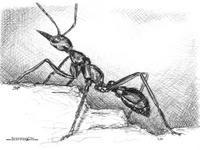
How: You have to be systematic about the blowing affair. After you decide that you would like the bug off your space, take a deep breath and pause momentarily. This is to dispel the Anticipation that you are about to let out a tempest. If you at all watch NatGeo, you might realize that an Antennae is very sensitive to micro-changes in the air densities around it. It can detect even the gentlest inhalation of air. (See pic below)


While you're holding your breath, see whether you can sense that the ant is still suspicious of something black in the lentils. After ensuring that it has let down its guards, in a 'Pphu', let out your breath all in one violent go. The faster you let go the better. If your breath's acceleration surpasses the AntFlight threshold, the ant will be successfully airlifted.
The 2.2% probability of backfiring is attributable to the chances of following occurring:
1. During the Pphu delivery, sometimes your throat constricts involuntarily. Air then tries to vent out from your nostrils, which seriously undermines the power of your blow.
2. During the Pphu, random misfires in synaptic nervous transmissions from your brain can cause your body muscles (especially in your arms and neck) to jerk. This will not foil your plan unless your bodily movement scares the ant, who will promptly assume a tighter Crouch.
3. After you pause in breath to chase away the suspicion, you might sometimes totally forget to exhale. This is a dangerous possibility, since your lungs, your blood vessels, and eventually your brain become devoid of oxygen, and consequently you experience rapid cellular atrophy. You are therefore advised to keep your mental cool, and practice the inhale-pause-exhale routine several times during the day. Youngsters below 12 years of age are strongly advised not to perform this method.
4. Sometimes, the ant is better equipped with extra-grip shoes. This greatly enhances the static friction between it and the surface it walks on. Here, you have no option but to plug in an electric blower to blast out a high-power wind. One dirty alternative is the PinkieFlick maneuver that I have already discussed above.
The Humane Way
If animal rights is your thing, place a few sugar granules on a liftable object (e.g., a postcard, a plastic sheet- make sure the surface is glossy and slippery). Then wait for the ant's antenna to pick up the sweet signals. Once the ant walks on the smooth grounds, you can pick up the object, point it to your trashcan, and blow the ant into the can. The success rate is not that high and this process can take a lot of time.
Spotting the bug can be quite an 'ants in your pants' experience. However, with the proper techniques, you will only feel sorry for the ant.

Labels: , , ,

Tuesday, August 30, 2005

To Catch a Fly

As I spend my day trying to de-idle my brain, I think a lot of things. My rule is not to banish any thought, be it worthless or not. I come up with many important baseless discoveries that more often than never uplift the human race. Besides, I empathise with the harassees of the houseflies. The annoying wing-beat hummers can drive anyone wild. So in a gesture of compassion, I have decided to share this amazing housefly-catching technique. And I will not bore you with the anatomy of the housefly, so read on.

The Schnook
when a housefly lands on a surface, do not infect your brain with any of hatred, frustration, or pity. Assume a cold, calculating mode. Remind yourself that you are doing this just because you can. Alternatively, you can adopt the Matrix philosophy and chant on: 'There's no housefly.' However, I doubt that you'll look cool with that chant, because
1. you're not Neo
2. you dont have cool shades
3. Neo is too cool to be bothered by flies, and
4. There IS a housefly.
When you have calmed your mind, and that your intentions are not impured by your emotions, lower your cupped palm on the surface near the fly, although sufficiently far enough so that it does not realize that it is about to get Schnooked. You are now going to sweep across the surface, and jerk your palm fully closed just as you are about to touch the fly. Almost always, it will notice your movement, and will take a flight. Therefore, you should estimate the displaced position the fly will be in.

The Head-on Swoop
The most important point is that your sweeping movement should be such that it meets the fly head-on. (If you cannot see its head, chances are that you forgot to wear your lenses, that you're too far from the fly, or that what you thought was a fly was a forgotten raisin.) This counterdirectional strategy allows you higher chances of success because a fly typically takes a longer time flying backwards than forward. This is in conjunction with the recent finding at Pradhan Labs that a housefly takes a longer time to take off if it is attacked from the front.

You need to practice to perfect this sweep, and build the swiftness in your paw. Once you get the hang of it, it will be as easy as catching a fly.

After you do a clean swoop, you might feel the reassuring buzz of the fly in your fist. You might feel:
1. disgusted that you're touching it with your palm
2. A Suffocating curiosity of whether you really DID capture it, making you want to open your fist just a bit to peer in, and
3. proud that you have a god's creation at your mercy in your fist 4. Intense hatred at the vile creature.

At these trying times, you should still keep your actions methodical, because losing composure is just not cool, and doing so will most of the time lead to the fly's escape.

The Death Fling
Once you make your catch, you have two options, one of which is to just open your fist and let the fly fly. However, most of the time, my listeners opt to kill the fly.
The most painless, clean killing method is the Death Fling. With a violent jerk, fling the fly onto a hard surface, preferably the ground, as gravity contributes to the velocity of the fling. Do not put too much effort into it, lest you dislocate your shoulder, or that you make a messy splotch of the fly in the ground. With experience and practice, you will in no time do the fling with such optimal force that the fly meets death but it actually bounces off the ground rather than lays splat on the floor.

The Scarecrow Method
With a few dead houseflies, you can deter other flies from so much as entering your domicile. All you have to do is dip the carcass in glue,and stick it to a piece of thread. Once it dries off, tape the thread on the doorways and windoways from the outside, so that it scares off those flies who are attempting to break in. You might need to collect quite a few carcasses, since the most effective way is to hang about 5 flies on every door and window. If that does not do the trick, you can post a miniature message, saying something like "Beware! The Death Flinger dwells here". These are the vital steps that you can follow to enjoy a fly-free zone.

Labels: , ,